Experience Architecture
Why Identity, Not Price or Product, Is the Real Driver of Guest Loyalty
By Anastacia Julie | Hybrid Founder | Experience Architect
Anastacia Julie ·
Twenty-six years ago, I walked onto a stage.
Not a hospitality floor. Not a boardroom. A performance stage and later, the polished interiors of luxury retail at Christian Dior.
What I carried from that first stage into every environment that followed luxury retail, real estate, recruitment, investments, insurance, film, entertainment, and hospitality was a single instinct. A quiet but persistent belief that the way you make someone *feel* in a space matters more than almost anything else you can offer them. More than the product. More than the price point. More than the aesthetic.
I didn't have language for it then. But I knew it was true.
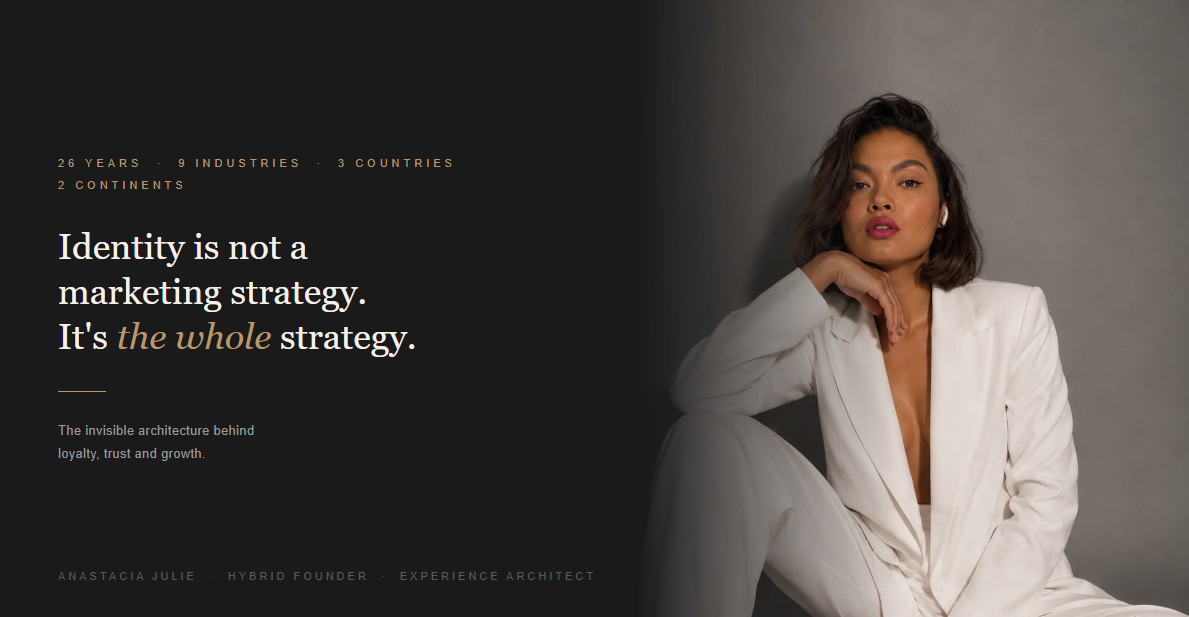
Twenty-six years. Nine industries. Three countries. Two continents. And the instinct has held in every single one of them.
I can finally articulate why.
*The Mistake Most Brands Make*
Most businesses build their guest experience around the product.
They ask: *What are we selling? How do we present it? How do we price it competitively?*
These are not wrong questions. But they are incomplete ones.
Because the guest doesn't experience your product in isolation. They experience it through the lens of how it makes them feel about *themselves.*
Does this place see me? Does it speak to who I am? Does it reflect something back to me that I recognise and value?
When the answer is yes, price becomes secondary. Alternatives become irrelevant. Loyalty becomes almost automatic.
When the answer is no, no amount of competitive pricing or product excellence will manufacture the connection you're missing.
I have watched this play out in property showrooms, recruitment firms, insurance offices, film sets, and five-star dining rooms. The environment changes. The dynamic does not.
*Identity Is the Invisible Architecture of Every Customer Journey*
The through line across nine industries and 26 years has never changed.
The clients who return, who advocate, who forgive occasional imperfection, who become genuinely loyal are always the ones who feel *seen* by the experience. Not just served. Seen.
This is identity at work.
When a brand understands who its customer is not just demographically, but emotionally, aspirationally, culturally, it can design touchpoints that speak directly to that identity. The greeting. The language. The pacing. The way a complaint is handled. The way a milestone is acknowledged.
These are not small details. These *are* the experience.
And the data is unambiguous. A Motista study of over 100,000 customers across more than 100 retailers found that emotionally connected customers have a **306% higher lifetime value** than customers who are merely satisfied — staying loyal for an average of 5.1 years versus 3.4 years, and recommending brands at nearly four times the rate. Harvard Business Review goes further, with research published in their article *"The New Science of Customer Emotions"* finding that fully connected customers are **52% more valuable** than those who are just highly satisfied.
Read that again. Not compared to dissatisfied customers. Compared to *satisfied* ones.
Satisfaction is not the goal. Connection is.
*What Nine Industries Taught Me That One Never Could*
Here is what moving across industries gives you that staying in one never does: pattern recognition at scale.
In real estate, I watched buyers choose a property not because it was the best on paper but because the agent made them feel understood. In recruitment, candidates who accepted offers were rarely the ones who got the highest salary. They were the ones who felt the company saw who they were *becoming*, not just who they were on a CV. In insurance and investments, trust was never built on the product. It was built on whether the client felt the advisor genuinely had their interests at heart.
In film and entertainment, audiences don't connect to storylines. They connect to characters that reflect something true about themselves back to them.
The product changes. The human need to feel seen does not.
This is why I have always believed that experience design is not a hospitality skill. It is a human skill. And it is the most underleveraged competitive advantage in almost every industry I have ever worked in.
*What Building SoftQueenOS Taught Me About All Of It
Tomorrow I open the beta doors for SoftQueenOS a life operating system built specifically for women. And in building it, I crystallised something I had been living professionally for 26 years but had never fully named.
The premise is simple: most productivity tools are built around a system, and women are expected to adapt to fit that system. SoftQueenOS inverts that entirely. The OS adapts around the woman her energy, her language, her mood, her capacity on any given day.
The result? Women don't feel like users of a tool. They feel *met.* Witnessed. Like the system was built for them specifically.
Sound familiar?
That is exactly what world-class customer experience does across every industry.
It doesn't ask the customer to adapt to the service model. It builds the service model around the customer. Around who she is, how she's arriving, what she needs to feel at her best in that moment.
*Before the world check in with yourself.*
That principle lives in SoftQueenOS. But it also lives in every exceptional experience I have ever been part of creating — regardless of the industry.
The Practical Questions Worth Asking
If you are leading any customer-facing business, in any industry, here are the questions I would sit with:
**Do you know who your customer actually is** not just their spend profile, but their identity? What do they value? How do they want to feel when they leave you?
**Does your team understand they are identity architects?** Every interaction either reinforces the customer's sense of self or disrupts it. Training needs to reflect that.
**Are your touchpoints consistent with your identity promise?** The marketing, the welcome, the complaint handling, the exit — do they all tell the same story about who your customer is to you?
**Are you designing for your customer's best self?** Not who they are when they're frustrated or rushed but who they're capable of being in the right environment?
The brands that answer these questions well are not necessarily the ones with the biggest budgets.
They are the ones with the clearest understanding of *who they are for.*
*The Customers Who Stay Are the Ones Who Feel Seen*
Twenty-six years. Nine industries. Three countries. Two continents.
The common denominator has never changed.
People don't stay loyal to products. They stay loyal to the places, brands, and experiences that reflect them back to themselves with clarity and care.
That is the work. In hospitality, in finance, in film, in tech. In every room I have ever walked into.
And I am more certain of that than ever.
*Anastacia is a Hybrid Founder and Experience Architect with 26 years across performance, luxury retail, real estate, recruitment, investments, insurance, film, entertainment and hospitality. She is the founder of SoftQueenOS, Anjainasia and Roam The Globe With Her.*
**Sources:**
- Motista, *"Leveraging the Value of Emotional Connection for Retailers"* (2018) — via PR Newswire
- Harvard Business Review, *"The New Science of Customer Emotions"* — Zorfas & Leemon